Inventory Logic
Understand how inventory is calculated, updated, and managed in Prosessed AI.
Overview
Inventory Logic defines how stock levels are tracked and updated across the system.
It ensures:
- Accurate stock quantities
- Real-time updates
- Proper stock movement tracking
Key Concepts
Stock Quantity
Represents the number of items available in a warehouse.
Warehouse
A physical or logical location where stock is stored.
Stock Movement
Any transaction that changes stock levels:
- Purchase → Increase
- Sale → Decrease
- Transfer → Move between warehouses
How Inventory Works
Inventory is updated based on transactions.
Stock Increase
Occurs when:
- Purchase Receipt is submitted
- Stock Entry (Material Receipt) is created
Stock Decrease
Occurs when:
- Delivery Note is submitted
- Sales Invoice (with stock update) is created
- Stock Entry (Material Issue) is created
Stock Transfer
Occurs when:
- Stock Entry (Material Transfer) is created
Inventory Flow
Purchase → Stock → Sales → Delivery → Payment
Stock is affected only during:
- Purchase Receipt
- Delivery / Stock Entry
Real-Time Updates
Inventory updates instantly when:
- A transaction is submitted
- Quantity changes are recorded
Reserved Stock
Stock can be reserved using Sales Orders.
Purpose:
- Prevent overselling
- Ensure availability for confirmed orders
Available Stock Calculation
Available stock is calculated as:
Available Stock = Actual Stock – Reserved Stock
Negative Stock
Negative stock occurs when:
- Sales exceed available stock
System can:
- Allow or restrict negative stock
Valuation Methods
Inventory value is calculated using:
FIFO (First In First Out)
- Oldest stock is used first
Moving Average
- Average cost is calculated continuously
Batch & Serial Logic
If enabled:
- Batch must be selected for transactions
- Serial number must be unique per item
Multi-Warehouse Logic
Stock is tracked separately per warehouse.
Example:
| Warehouse | Stock |
|----------|------|
| Main | 100 |
| Secondary | 50 |
Stock Ledger
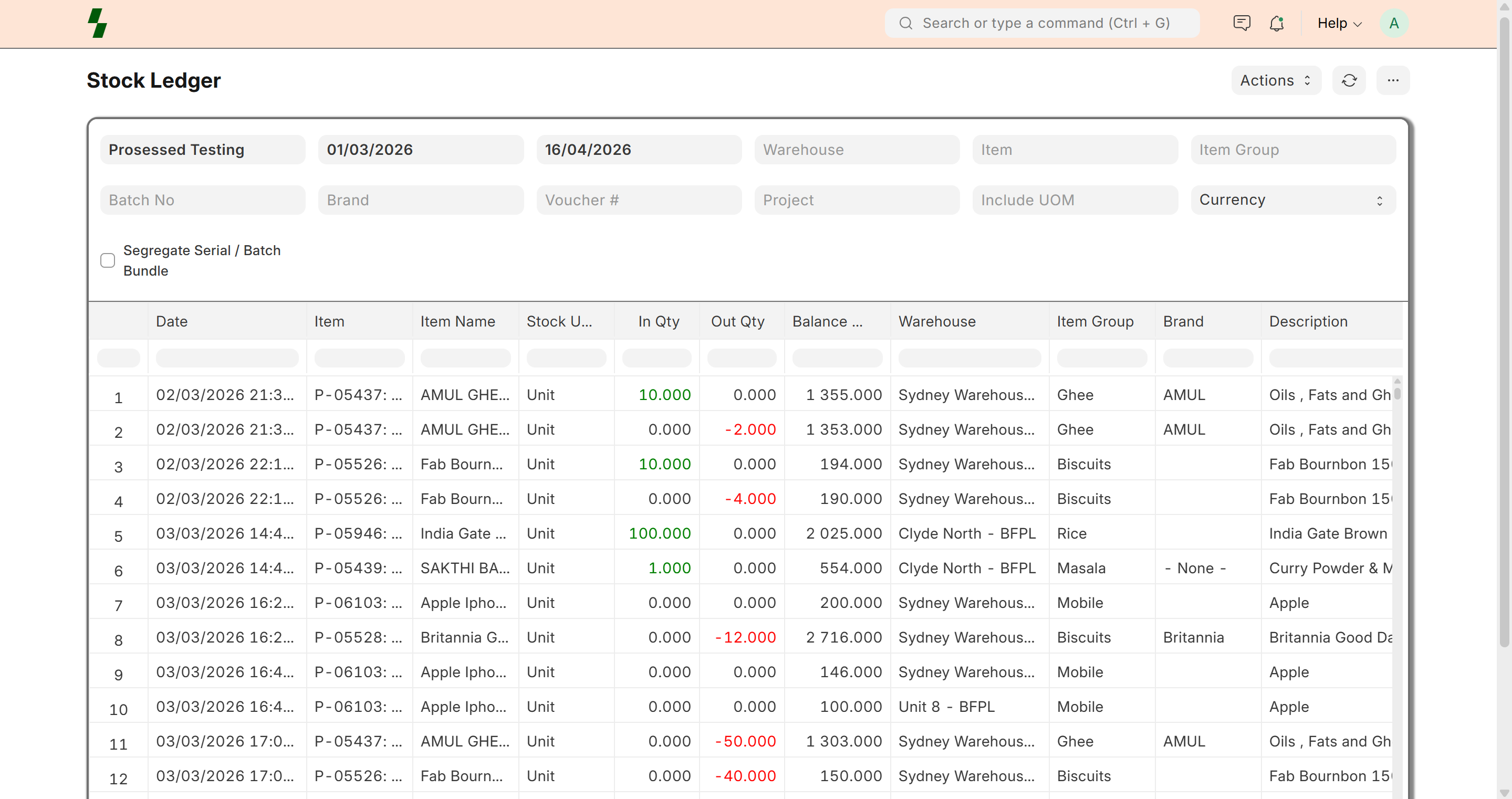
All stock movements are recorded in:
👉 Stock Ledger
This includes:
- Date
- Item
- Quantity change
- Transaction type
Inventory Accuracy
Accuracy depends on:
- Correct stock entries
- Proper transaction flow
- Regular reconciliation
Common Scenarios
Scenario 1: Purchase
- Receive 100 units
- Stock increases to 100
Scenario 2: Sale
- Sell 20 units
- Stock reduces to 80
Scenario 3: Transfer
- Move 30 units to another warehouse
- Stock updates per warehouse
Best Practices
- Always use proper transactions
- Avoid manual stock changes
- Reconcile stock regularly
- Track warehouse-wise inventory
Common Issues
- Stock mismatch → Check stock entries
- Negative stock → Verify transactions
- Incorrect valuation → Check costing method
Why It Matters
Inventory logic ensures:
- Accurate stock tracking
- Smooth operations
- Better decision-making